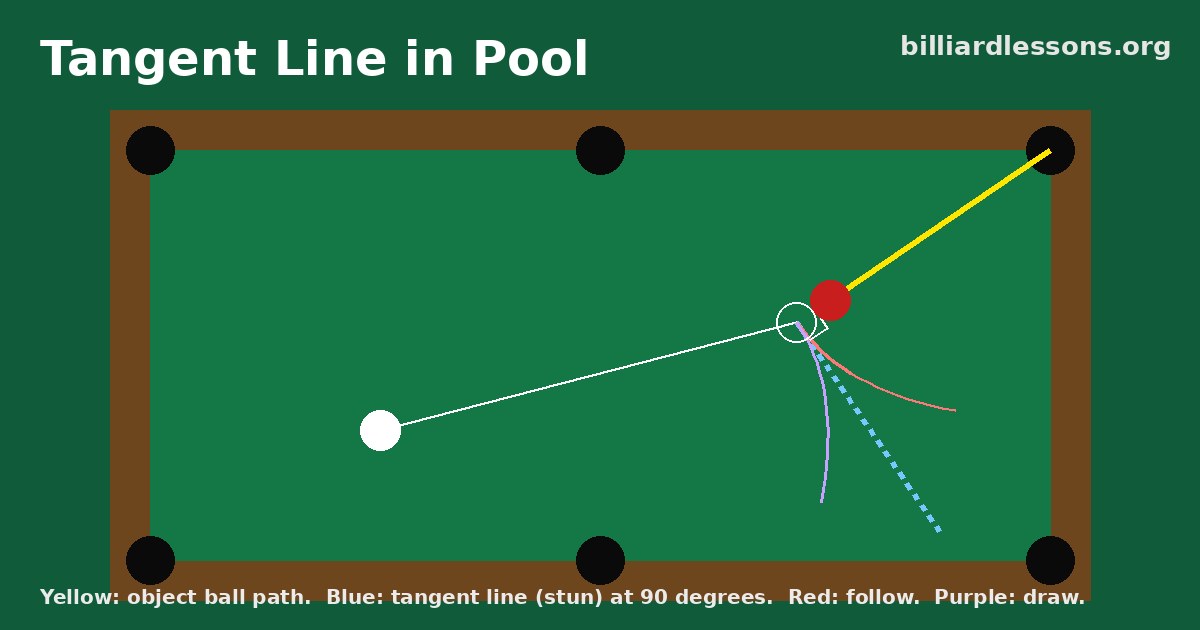
Quick answer: The tangent line in pool is the path the cue ball takes after it hits an object ball on a cut shot, when the cue ball has no spin at contact. That path is at a right angle, or 90 degrees, to the path of the object ball. To find it, picture the line the object ball will travel to the pocket. Then picture a line through the cue ball’s spot at contact that crosses that line at 90 degrees. Follow bends the cue ball forward of the tangent line. Draw bends it back. Learning this line helps you avoid scratches and get shape for your next shot.
Every time you hit a ball, the cue ball goes somewhere. Good players know where before they shoot. The tangent line is the first tool they use to see it. Once you learn it, you stop guessing where the cue ball will end up.
Key Takeaways
- The tangent line is 90 degrees from the object ball’s path.
- It is exact for a stun hit, where the cue ball is sliding with no spin at contact.
- Follow makes the cue ball curve forward of the line. Draw makes it curve back.
- On a dead straight shot there is no tangent line. A stun hit just stops the cue ball.
- Use it to spot scratches and plan where the cue ball goes next.
What Is the Tangent Line?
Picture the cue ball sitting where it will touch the object ball. Many players call this spot the ghost ball. Now draw a line from the center of the ghost ball through the center of the object ball. That is the line the object ball travels after contact.
The tangent line runs through the ghost ball and crosses that object ball line at a right angle. It looks like the letter T laid on its side. When the cue ball is sliding with no spin at contact, it leaves along this line.
Many teachers call this the 90 degree rule. It works for any cut angle, from a thin cut to a thick one, as long as the cue ball has no top or back spin at contact.
Why the Tangent Line Matters
- You can see scratches before they happen. If the tangent line points at a pocket, a stun hit may send the cue ball in.
- You can plan position. You know where the cue ball starts to travel, so you can pick a spot for your next shot.
- You can see a kiss. If another ball sits on the tangent line, the cue ball may hit it.
- It is the base for every spin shot. Follow and draw only make sense once you know the starting line.
How to Find the Tangent Line
- Find the object ball line. Look from the pocket back through the object ball. This is where the ball needs to go.
- Find the ghost ball. It is the spot right behind the object ball on that line, where the cue ball will touch it.
- Turn 90 degrees. Picture a line through the ghost ball that is square to the object ball line.
- Check both ends. The cue ball goes the direction it was already heading. On a cut to the left, it goes right along the line, and on a cut to the right, it goes left.
A simple trick is to hold your cue over the table. Lay it along the object ball line, then turn it a quarter turn at the ghost ball. That shows you the tangent line.
Stun, Follow and Draw Change the Path
The tangent line is exact only when the cue ball is sliding at contact. That is called a stun shot. Spin changes the path right after contact.
- Stun: The cue ball leaves along the tangent line. Hit a touch below center so the cue ball is still sliding when it gets there.
- Follow: Hit above center. The cue ball starts on the tangent line, then curves forward toward the object ball’s side.
- Draw: Hit below center. The cue ball starts on the tangent line, then curves back toward you.
A natural rolling cue ball also bends forward. On a normal cut, many teachers say a rolling cue ball leaves at about 30 degrees from the object ball’s path. That is called the 30 degree rule, and it is a good next step after you learn the tangent line.
Speed matters too. A harder hit keeps the cue ball on the tangent line longer before the spin takes over. A soft hit lets the spin bend the path sooner.
To learn where to hit for each spin, read our post on where to hit the cue ball.
The Straight In Shot
On a dead straight shot, there is no cut, so there is no tangent line to follow. With a stun hit, the cue ball stops right where the object ball was. That is a stop shot. With follow, the cue ball rolls forward after the object ball. With draw, it comes straight back.
A Simple Tangent Line Drill
- Put an object ball about one foot from a corner pocket.
- Set the cue ball for a half ball cut, a medium cut angle.
- Lay a piece of chalk on the table where you think the tangent line will send the cue ball, about two feet past the ghost ball.
- Shoot with a stun hit, a touch below center, and medium speed.
- Watch the cue ball. Did it pass near the chalk?
- Shoot 10 times. Then move the cue ball to a new angle and try again.
When stun gets easy, try the same shot with follow and then draw. Watch how the path bends away from the line. Our pool drills for beginners give you more ways to practice.
Common Mistakes
- Rolling the cue ball when you meant to stun. From far away, a center hit may start to roll before contact. Hit a little lower.
- Forgetting the scratch. Always check where the tangent line points before you shoot.
- Looking only at the object ball. Take a second during your pre shot routine to see where the cue ball will go.
- Rushing the stroke. A smooth stroke gives you the spin you plan. See how to follow through in pool.
Learn More
The tangent line is the first step in cue ball control. Next, read how to improve cue ball control and how to line up a pool shot. Ted’s video below walks you through tangent line practice on a real table, and Part 2 of the tangent line lesson goes further.
Pool Billiards Game has more on cue ball control, the draw shot in pool, and the follow shot in pool. The main site at Pool Billiards Game has rules and lessons for every game. If you play 8 ball, 8 Ball Winning Strategies shows how knowing the cue ball path helps you plan a whole rack.
Watch: Tangent Line Practice: Control Your Cue Ball in Pool, Part 1 (Pool Skool with Ted)
Keep Reading on This Site
- How to Draw the Cue Ball in Pool: 7 Steps to a Clean Draw Shot
- Billiard Lessons for Beginners: 7 Free Steps to Play Better Pool
- How to Chalk a Pool Cue: 6 Simple Steps and Common Mistakes
- Pool Stance for Beginners: 6 Steps to a Solid, Balanced Stance
- Open Bridge vs Closed Bridge in Pool: Which One Should You Use?
- How to Warm Up Before Playing Pool: A 15 Minute Routine
About the Author
I am Ted Mauro. I have played pool for more than 50 years and in leagues and tournaments for more than 38 years. I teach the game through my Pool Skool and my YouTube channel, Pool Skool with Ted.
Frequently Asked Questions
What is the tangent line in pool?
It is the path the cue ball takes after a cut shot when it has no spin at contact. It is at 90 degrees to the path of the object ball.
What is the 90 degree rule in pool?
It is another name for the tangent line idea. With a stun hit, the cue ball and the object ball split apart at a right angle.
Does the tangent line work with follow and draw?
The cue ball starts on the tangent line, then the spin bends it. Follow bends it forward and draw bends it back.
Is there a tangent line on a straight shot?
No. On a straight shot, a stun hit stops the cue ball in place, follow sends it forward, and draw brings it back.
How do I practice the tangent line?
Set up a medium cut, mark where you think the cue ball will go, and shoot stun shots. Watch how close the cue ball comes to your mark.
Why does my cue ball not follow the tangent line?
It probably had some roll or spin at contact. Hit a touch below center so it is sliding when it reaches the object ball.