Quick answer: To draw the cue ball in pool, hit it below center so it spins backward. Keep your cue as level as you can, use a loose grip, and make a smooth stroke that follows through past where the cue ball was. When the cue ball hits the object ball, the backspin pulls it back toward you. Start with short, straight in shots and low to medium speed. Most missed draw shots come from hitting too close to center, jerking the stroke, or stopping the cue at contact.
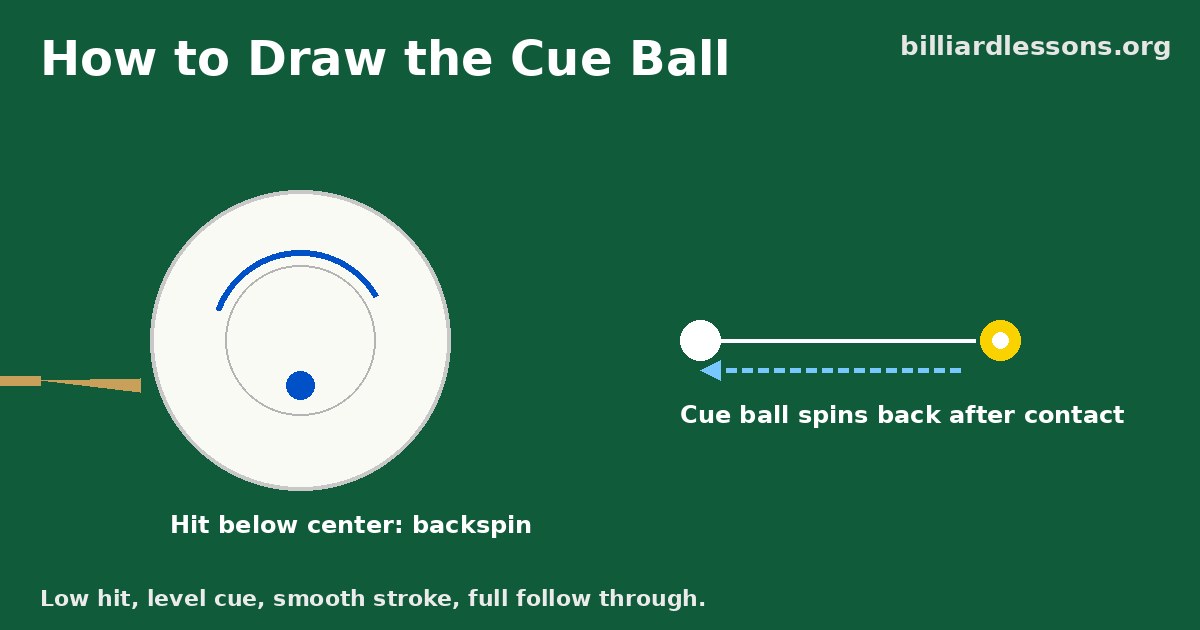
The draw shot is one of the first big skills in pool. It feels like magic the first time the cue ball spins back to you. But it is not magic. It is just a low hit and a good stroke. This post shows you how to do it step by step.
Key Takeaways
- Draw comes from hitting the cue ball below center.
- A level cue, a loose grip, and a full follow through matter more than power.
- Start close to the object ball and build up distance.
- Chalk before every draw shot to avoid a miscue.
- Practice with a simple straight in drill.
What Is a Draw Shot?
A draw shot is a shot where the cue ball comes back toward you after it hits the object ball. You do this by putting backspin on the cue ball. Some players just call it backspin or “screw,” which is the word many players in the UK use.
Draw helps you get position for your next shot. It also helps you avoid scratches when the cue ball would roll into a pocket behind the object ball.
How to Draw the Cue Ball in 7 Steps
- Chalk your tip. A low hit needs good grip between the tip and the ball. See how to chalk a pool cue.
- Set a low bridge. Lower your bridge hand so the tip lines up below the center of the cue ball. Our guide on open bridge vs closed bridge can help you pick one.
- Aim below center. Start about one tip width below center. Go lower as you get better, but stay inside the safe zone so you do not miscue.
- Keep the cue level. Raise the back of your cue only as much as you need to clear the rail. A level cue helps the ball spin back, not jump.
- Loosen your grip. A tight grip makes a jerky stroke. Hold the cue gently, like you are holding a small bird. Read how to hold a pool cue for more.
- Stroke smooth and follow through. Let the cue keep going a few inches past where the cue ball was. Stopping at contact kills the spin. See how to follow through in pool.
- Stay down. Keep your head still until the cue ball comes back. Getting up early moves your stroke.
How Hard Should You Hit a Draw Shot?
Not as hard as you think. Many players try to power the ball back and end up missing. A smooth, medium stroke with a good low hit draws better than a wild, hard one.
Distance changes things. The cue ball loses some backspin as it travels across the cloth. When the object ball is far away, you need a lower hit, a bit more speed, or both, so some spin is still there at contact. Start close and move back as you get better.
Draw on Cut Shots
On a straight in shot, the cue ball comes straight back. On a cut shot, the cue ball first heads along the tangent line, then the backspin bends it back. Learn more in our page on the tangent line in pool. For a full map of where to hit for each spin, read where to hit the cue ball.
A Simple Draw Shot Drill
- Put an object ball about one foot from a corner pocket.
- Put the cue ball one foot behind it, in a straight line with the pocket.
- Shoot 10 draw shots. Try to make the ball and bring the cue ball back about one foot.
- Count how many work.
- Move the cue ball back another foot and do it again.
When you can draw the cue ball back a foot from three feet away, try to bring it back to a spot you choose, like a piece of chalk on the table. That turns draw into real position play. Our pool drills for beginners have more practice ideas.
Common Draw Shot Mistakes
- Hitting too close to center. You think you hit low, but you did not. Check the tip before you stroke.
- Jerking the stroke. A quick jab at the ball adds power but takes away spin.
- No follow through. Stopping the cue at contact cuts off the draw.
- Lifting up. Standing up early moves the cue. Read how to keep your head down in pool.
- Missing the low hit and miscuing. Too low with no chalk can make the tip slide off. See how to stop miscuing.
Learn More
Ted’s video below shows stop, draw, and follow in 90 seconds on a real table. Pool Billiards Game has a full page on the draw shot in pool plus cue ball control drills. The main site at Pool Billiards Game has rules and lessons for every game. If you play 8 ball, 8 Ball Winning Strategies shows how draw and other cue ball skills help you plan a whole rack.
Watch: Stop, Draw and Follow: The 3 Basic Pool Shots in 90 Seconds (Pool Skool with Ted)
Keep Reading on This Site
- Tangent Line in Pool: Where the Cue Ball Goes After It Hits a Ball
- Billiard Lessons for Beginners: 7 Free Steps to Play Better Pool
- How to Chalk a Pool Cue: 6 Simple Steps and Common Mistakes
- Pool Stance for Beginners: 6 Steps to a Solid, Balanced Stance
- Open Bridge vs Closed Bridge in Pool: Which One Should You Use?
- How to Warm Up Before Playing Pool: A 15 Minute Routine
About the Author
I am Ted Mauro. I have played pool for more than 50 years and in leagues and tournaments for more than 38 years. I teach the game through my Pool Skool and my YouTube channel, Pool Skool with Ted.
Frequently Asked Questions
How do you draw the cue ball in pool?
Hit the cue ball below center with a level cue and a smooth stroke that follows through. The backspin brings it back after it hits the object ball.
Why won't my cue ball draw back?
Most of the time you are hitting too close to center, jerking the stroke, or stopping the cue at contact. Hit lower and follow through.
Do you need to hit hard to draw the ball?
No. A smooth medium stroke with a good low hit works better than a hard, jerky one. You may need a bit more speed when the balls are far apart.
Why does my cue ball jump when I try to draw?
Your cue may be raised too high. Keep the back of the cue as low as you can.
How low should I hit for a draw shot?
Start about one tip width below center. Go a little lower as you improve, but not so low that you miscue.
What is the difference between draw and backspin?
They are the same thing. Draw is the name of the shot, and backspin is the spin that makes it work.