Quick answer: Pool stroke drills are short practice routines that train your cue to move straight back and straight through the cue ball. The best simple ones are: shoot the cue ball down the table and back to your tip, stroke through the neck of an empty bottle, stroke along the straight seam on the rail, shoot straight in shots, and practice a slow set, pause, and finish. Do each drill for 5 to 10 minutes. If the cue ball comes back off line or your cue wobbles, slow down and check your grip, elbow, and follow through.
A straight stroke is the base of everything in pool. You can aim perfectly and still miss if the cue moves off line. These drills take very little time, and most need nothing but a table, a cue, and the cue ball.
Key Takeaways
- A straight stroke means the cue goes back and through on the same line.
- Most stroke drills need only the cue ball, so you can do them alone.
- Go slow first. Speed comes after the motion is straight.
- A loose grip and a still elbow fix many stroke problems.
- Practice a few minutes every time you play, not just once in a while.
What Makes a Good Pool Stroke?
A good stroke has three parts. First, your back swing is smooth and slow. Second, you pause for a moment at the back. Third, you move forward through the cue ball and keep going. That last part is the follow through.
Your upper arm should stay still. The forearm swings from the elbow like a pendulum. Your grip should be light, like you are holding a small bird. A tight grip pulls the cue off line. If you want to learn more about the parts, read our page on how to build a consistent pool stroke.
Drill 1: Cue Ball Down and Back
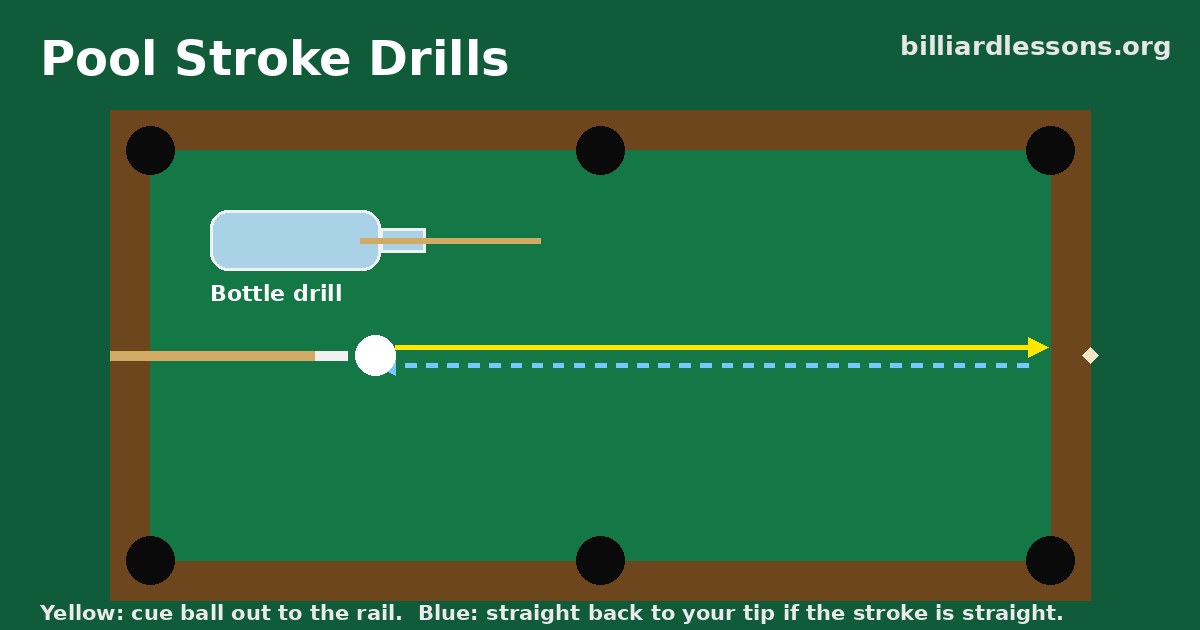
This is a classic test. Put the cue ball on the head spot. Aim at the center diamond on the far short rail. Shoot with a center hit and medium speed. The cue ball should travel down the table, hit the rail, and roll straight back to your cue tip.
- If it comes back to the left or right, your stroke moved off line or you hit with side spin.
- Keep your cue down and still after the hit, so the cue ball can come back to it.
- Do 10 shots. Count how many come back to your tip.
Ted has a video on this one, called Straight Stroke Drill: Cue Ball Down and Back.
Drill 2: The Bottle Drill
Lay an empty plastic bottle on its side and tape it down, or have a friend hold it. Slide your cue tip into the neck. Make slow practice strokes without the cue touching the sides of the neck. The narrow opening shows you right away if the cue wobbles.
This drill works away from the table too. That makes it a nice choice on days you cannot get to a pool hall. Watch Ted do it in Straight Stroke Drill: Shoot Through a Bottle.
Drill 3: Cover the Seam
Many tables have a straight seam line in the cloth along the rail. Set your bridge so the cue lies right over that line. Stroke back and forth slowly. Try to keep the cue covering the seam the whole time. If you see the line peek out on one side, the cue is moving off line. The video below shows this drill.
Drill 4: Straight In Shots
Put an object ball about a foot from a corner pocket. Put the cue ball in line with it, a few feet back. Shoot it straight in. On a straight shot, any stroke error shows up as a miss or a cue ball that drifts to the side.
Start close. When you make 10 in a row, move the cue ball back a little. See Ted’s Beginner Pool Drill: Shoot Balls Straight In for this one, and our pool drills for beginners for more.
Drill 5: Set, Pause, Finish
This drill trains the rhythm of the stroke.
- Set. Get down on the shot and put your tip near the cue ball. Hold still.
- Back. Draw the cue back slowly.
- Pause. Stop for a moment at the back.
- Finish. Stroke through the cue ball and freeze at the end. Leave the cue where it stops.
Say the words in your head as you go. Ted shows this in Set, Pause, Finish: A Smooth Pool Stroke. Our page on how to follow through in pool explains the finish.
Common Stroke Problems and Quick Fixes
| Problem | What you see | Quick fix |
|---|---|---|
| Steering | Cue swings to the side as you hit | Look at the object ball and trust your aim |
| Dropping the elbow | Cue dips down through the shot | Keep the upper arm still |
| Tight grip | Jerky stroke, cue ball jumps | Hold the cue lightly |
| Rushing | No pause at the back | Use set, pause, finish |
| Lifting your head | Cue ball goes off line | Stay down until the ball stops |
Read how to stop steering the cue in pool and how to stop dropping your elbow in pool for more help.
How Often Should You Do Stroke Drills?
A few minutes at the start of each session is a good habit. It works like a warm up. Pick one or two drills, not all five. Write down your results so you can see progress. Our page on how to set goals for pool practice can help you plan.
Learn More
Pool Billiards Game has a full page on the pool stroke and more billiard drills. The main site at Pool Billiards Game has free lessons on all the fundamentals. If you play 8 ball, 8 Ball Winning Strategies shows how a steady stroke helps you plan and run a rack.
Get the book and the 7 Part Billiards Fundamentals PDF. One payment of $37. 60 day money back guarantee.
 Scan to get the book
Watch: Straight Stroke Drill: Cover the Seam (Pool Skool with Ted)
Keep Reading on This Site
- Pool Runout Drills: How to Practice Running 3 Balls, Then 6, Then the Rack
- Billiard Lessons for Beginners: 7 Free Steps to Play Better Pool
- How to Chalk a Pool Cue: 6 Simple Steps and Common Mistakes
- Pool Stance for Beginners: 6 Steps to a Solid, Balanced Stance
- Open Bridge vs Closed Bridge in Pool: Which One Should You Use?
- How to Warm Up Before Playing Pool: A 15 Minute Routine
About the Author
I am Ted Mauro. I have played pool for more than 50 years and in leagues and tournaments for more than 38 years. I teach the game through my Pool Skool and my YouTube channel, Pool Skool with Ted.
Frequently Asked Questions
What is the best drill for a straight pool stroke?
A simple one is to shoot the cue ball down the table off the far rail and see if it comes straight back to your cue tip.
Can I practice my pool stroke without a table?
Yes. The bottle drill works at home. You stroke through the neck of an empty bottle without touching the sides.
How long should I do stroke drills?
A few minutes at the start of each session is enough for most players. Pick one or two drills and do them well.
Why does my cue ball not come straight back?
Your cue may be moving off line, or you may be hitting a little left or right of center. Slow down and keep your grip loose.
How do I stop my cue from wobbling?
Hold the cue lightly, keep your upper arm still, and pause at the back of your stroke before you go forward.
Should I use a training aid?
You do not need one to start. The drills on this page use only a cue, the cue ball, and the table, or a bottle at home.
Get the book and the 7 Part Billiards Fundamentals PDF. One payment of $37. 60 day money back guarantee.
Scan to get the book